.png)
Unlocking PCIe Expansion in Dense AI Infrastructure
Updated: Sep 15
Modern AI, machine learning, and high-performance computing (HPC) platforms demand immense compute acceleration and high-speed data throughput. However, system architects and AI administrators routinely hit a physical wall: PCIe slot starvation.
In compact 1U, 2U, and edge server nodes, physical motherboard slots are scarce, rigid riser cards restrict airflow, and host CPUs lack sufficient lane allocation or native bifurcation support to expand peripherals seamlessly.
HighPoint addresses these architectural constraints with an ecosystem of PCIe Gen 5 MCIO Expansion Solutions. By combining high-density MCIO (Mini Cool Edge IO) cabling with modular bridge cards and intelligent PCIe switching and Retimer adapters, administrators can route Gen 5 bandwidth anywhere within the existing chassis to add full-bandwidth PCIe slots, GPUs, DPUs, and NVMe arrays without reengineering the entire computing platform.
HighPoint’s Approach to MCIO Expansion
HighPoint’s expansion architecture is divided into three distinct hardware tiers to match different system topologies, BIOS capabilities, and density requirements.
1. Direct Onboard MCIO Expansion
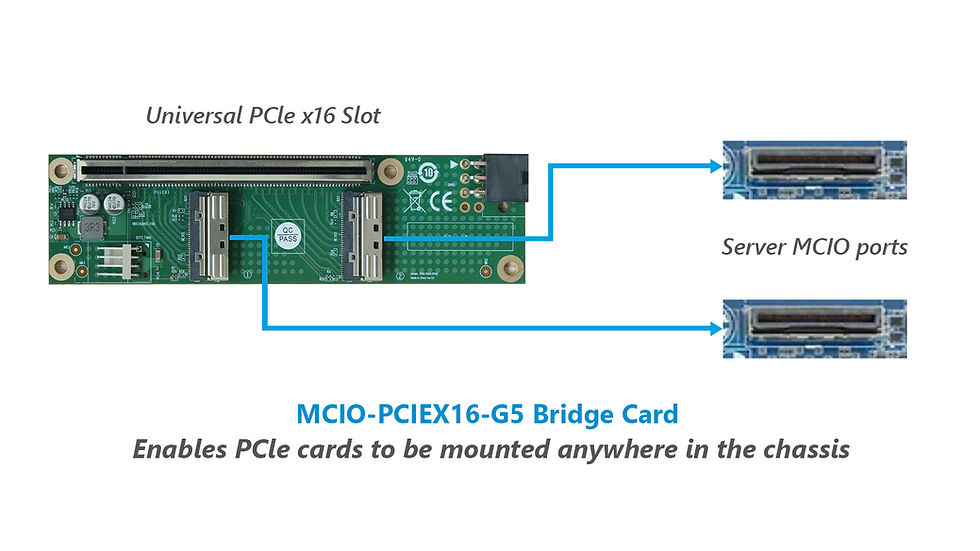
The Architecture: Motherboard Onboard MCIO 8i Ports + MCIO-PCIEX16-G5 Bridge Card
How It Works: Modern server motherboards (AMD EPYC, Intel Xeon) and carrier boards feature native onboard MCIO 8i connectors. HighPoint’s MCIO-PCIEX16-G5 bridge card accepts dual MCIO 8i connections and converts them directly into a physical, full-length PCIe 5.0 x16 expansion slot.
Primary Pain Point Addressed: Unused native board connectivity and severe slot scarcity. It provides a dedicated PCIe x16 slot without consuming any physical host PCIe slots on the motherboard.
2. Retimer / Bifurcation-Dependent Expansion

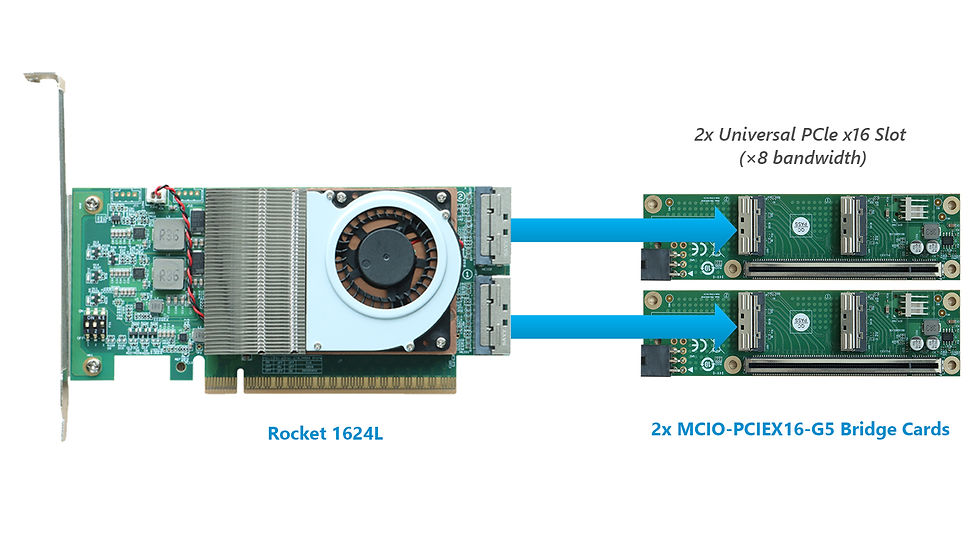
The Architecture: Rocket 1624L (Internal MCIO) or Rocket 1624M (External MCIO) + MCIO-PCIEX16-G5 Bridge Card
How It Works: This tier utilizes PCIe Gen 5 retimer adapters to extend host PCIe signals over internal or external cabling while maintaining signal integrity at 32 GT/s. The host slot relies on PCIe bifurcation (e.g., x16 bifurcated to x8/x8 or x4/x4/x4/x4) to split the bus across dual MCIO 8i ports.
Primary Pain Point Addressed: Signal degradation over long cable runs and rigid mechanical layout limitations. It allows administrators to cost-effectively relocate high-power cards (like GPUs or NICs) to auxiliary bays or external enclosures with minimal latency.
3. Switch-Based Advanced MCIO Expansion

The Architecture: Rocket 1628A (4x MCIO 8i) or Rocket 1624A (2x MCIO 8i) + MCIO-PCIEX16-G5 Bridge Card
How It Works: These adapters utilize Broadcom PCIe Gen 5 switch ICs to create a dedicated, independent internal PCIe switching fabric. They do not require host motherboard bifurcation and run off native OS bus drivers. Administrators can link the MCIO ports to the MCIO-PCIEX16-G5 bridge card to create an extra PCIe x16 or dual x8 peripheral slots, or route links directly to high-density U.2/U.3/E3.S NVMe storage backplanes.
Primary Pain Point Addressed: Bifurcation limitations, host CPU overhead, and peer-to-peer latency bottlenecks. The integrated switch enables Direct Peer-to-Peer (P2P) communication—allowing accelerators and storage to communicate across the switch fabric without loading the host CPU or traversing system RAM.
Architectural Comparison Matrix
Solution Tier | Core Hardware | Bifurcation Required? | Host PCIe Slot Consumed? | Max Bandwidth | Key AI / Enterprise Capability |
Tier 1: Direct Onboard | Onboard MCIO + MCIO-PCIEX16-G5 | System Dependent | No (Uses onboard ports) | PCIe 5.0 x16 (64 GB/s) | Zero PCIe host slot footprint; converts native board ports into GPU/NIC slots. |
Tier 2: Retimer / Bifurcation | Rocket 1624L/M + MCIO-PCIEX16-G5 | Yes (Host must support x8/x8) | Yes (1x x16 Slot) | PCIe 5.0 x16 (64 GB/s) | Low-cost signal extension for internal/external remote card placement. |
Tier 3: Intelligent Switch | Rocket 1624A / 1628A + MCIO-PCIEX16-G5 | No (Built-in Switch Engine) | Yes (1x x16 Slot) | PCIe 5.0 x16 (64 GB/s aggregate) | Direct P2P GPU/NIC offload, concurrent NVMe + compute expansion, universal motherboard support. |
Choosing the right Tier
Select Tier 1 - Direct Onboard connection (MCIO + MCIO-PCIEX16-G5 add up to 2x PCIe x8 Slots or a single x16 Slot): when your server motherboard already features unpopulated MCIO 8i connectors and you need an extra GPU, DPU, or capture card without consuming existing PCIe expansion slots.
Select Tier 2 - Retimer-Based (Rocket 1624L/1624M- add up to 2x PCIe x8 Slots or a single x16 Slot): when running platforms that fully support PCIe bifurcation, and your primary goal is clean internal thermal layout or external chassis extension at minimal component cost.
Select Tier 3 - Switch-Based (Rocket1624A/1628A – add up to 4x PCIe x8 slots or 2x PCIe x16 Slots): when designing high-throughput AI inference nodes, HPC clusters, or mixed compute/storage servers. This is mandatory for systems lacking robust BIOS bifurcation, environments requiring direct P2P device communication, or setups multiplexing multiple SSD arrays alongside dedicated accelerators.
Learn More


Weather resistance is an important consideration when investing in a commercial retractable roofing system. The selected design should account for local rainfall, wind exposure, sunlight intensity, and seasonal temperature changes. Appropriate materials, secure operating mechanisms, and professionally designed drainage features can help support dependable performance. Businesses should also https://cabriostructures.com/ understand the manufacturer's operating limits and recommended precautions during severe weather. Proper planning ensures that the roof is used appropriately while protecting occupants, equipment, furnishings, and the surrounding building structure.
When comparing discounted two-way radios, buyers should focus on the combination of price, performance, and suitability. A model with extensive features may not be the best option if those functions are unnecessary for the intended application. Conversely, choosing the cheapest available device can create problems when coverage or battery life falls short. Reviewing specifications, compatibility, warranty terms, and supplier reliability helps establish overall value. Careful comparison supports informed purchasing and helps individuals and organizations select dependable https://discounttwo-wayradio.com equipment within their budgets.i like this post.
Privacy is another factor that may influence the choice of a retractable pool enclosure. Depending on the surrounding property and enclosure design, the structure may create a more defined swimming environment. Certain panel configurations, landscaping arrangements, or architectural features can further support privacy. However, transparency is often desirable when homeowners want to maintain outdoor views. Because https://www.coversinplay.com designs vary widely, property owners can consider both openness and privacy when selecting the structure that best fits their preferences and property layout.
Modern AI infrastructure continues to evolve as businesses look for ways to improve performance, scalability, and hardware efficiency. PCIe expansion plays an important role in supporting high-speed connectivity and accommodating essential components such as GPUs, accelerators, and storage devices in dense computing environments. Understanding these technologies can help organizations make smarter decisions when building reliable systems. On a different note, fashion enthusiasts who enjoy playful character-inspired styles may like the Mickey Mouse Bomber Jacket for its distinctive design and sporty, casual appeal.
Great breakdown, the comparison matrix alone answered half the questions our team has been arguing about for weeks. We run a small colo in Sydney, and one of our biggest clients operates https://thepokies-aud.co platforms. They’ve been pushing real-time fraud and anomaly detection models onto dense 2U nodes, and we hit exactly the slot starvation you describe: one GPU per node, no room for the extra NVMe tier they need for feature caching. The kicker is that their older Xeon boards have very limited bifurcation options in BIOS, so Tier 2 was never going to work cleanly. Tier 3 with the Rocket 1628A looks like the right fit, especially for direct P2P between the GPU and NVMe without dragging everything through…