.png)
Switch-Based vs. Retimer-Based MCIO Adapters: Architectural Comparison
Updated: 2 days ago
Selecting the right PCIe Gen 5 MCIO expansion adapter determines your system’s scaling limits, drive density, host compatibility, and virtualization boundaries. While both switch-based and retimer-based adapters leverage high-density Mini Cool Edge IO (MCIO / SFF-TA-1016) cabling, they solve fundamentally different architectural challenges.
Examining the Architectural Differences
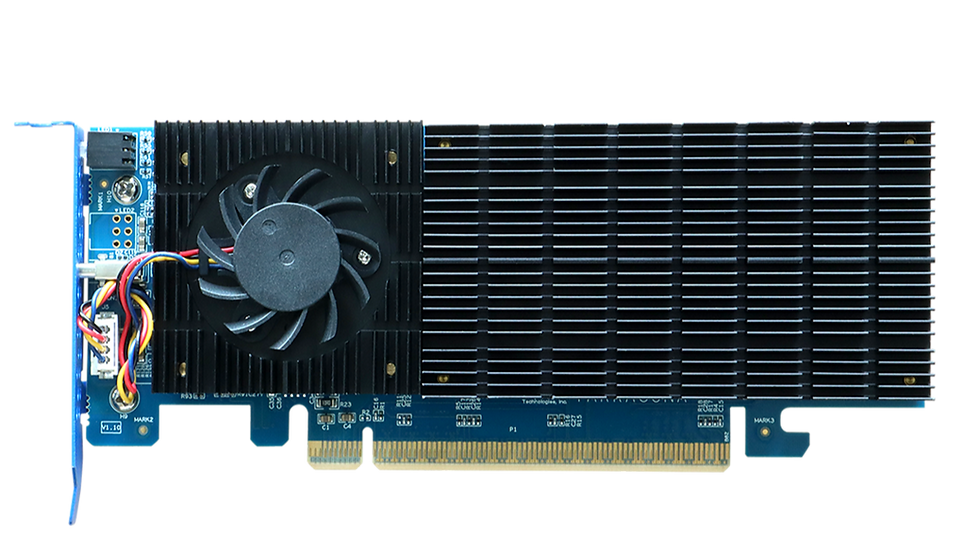
Switch-Based Adapters (Rocket 1628A, Rocket 1624A)
· Unified Compute & Storage Expansion: A dedicated 48-Lane Broadcom PCIe Gen 5 switch IC and embedded processor enables these adapters to function as autonomous PCIe fabrics. Pairing these adapters with MCIO-PCIEX16-G5 bridge cards can transform each MCIO port into physical PCIe 5.0 x16 slot: up to 4x slot at x8 speeds or 2x full-bandwidth x16 slots – ideal for adding GPUs, DPUs, FPGAs, and 400GbE NICs.
· Massive Drive Density: The flagship Rocket 1628A’s four MCIO 8i ports directly support up to 8 NVMe SSDs (U.2, U.3, E3.S, E1.S) or up to 32 NVMe drives via UBM/VPP-compliant backplanes.
· No Host Bifurcation Required: These adapters are designed to operate in any standard PCIe x16 slot without relying on motherboard BIOS bifurcation settings.
· Peer-to-Peer (P2P) Direct Transfer: Provides direct data pathways between all hosted PCIe devices (GPUs, DPUs, NICs, and NVMe drives) bypassing the host CPU and system DRAM to eliminate latency.

1. Retimer-Based Adapters (Rocket 1624L, Rocket 1624M)
· Signal Conditioning & Extension: Retimers adapters sample, re-time, and re-equalize PCIe 5.0 signals (32 GT/s) across longer trace lengths and cables, enabling PCIE cards to be mounted far away from the host CPU without compromising the signal quality or introducing latency
· Point-to-Point PCIe Slot & Storage Extension: Each adapter is equipped with two MCIO 8i ports, which direct support up to four NVMe drives, or pair with an MCIO-PCIEX16-G5 bridge card to relocate 1–2 remote PCIe slots within the host chassis.
· Host Bifurcation Requirement: The host motherboard and BIOS must support PCIe bifurcation (such as x8/x8 or x4/x4/x4/x4) to allocate lanes to each downstream device.

PCIe Slot Expansion
A major advantage of the MCIO ecosystem is the ability to bypass rigid physical risers and build flexible compute, networking, or hybrid configurations using HighPoint’s MCIO-PCIEX16-G5 expansion bridge card.

· Switch-Based Multi-Slot & Hybrid Fabric (Rocket 1628A / 1624A): The 48-lane switch allows system builders to mix and match workloads on a single card. For example, the Rocket 1628A can allocate 2x MCIO ports to drive a full-bandwidth GPU/accelerator slot via a bridge card, while dedicating the remaining 2x MCIO ports to an ultra-dense 16-to-32 drive NVMe backplane or auxiliary 400GbE NICs.
· Retimer Point-to-Point Extension (Rocket 1624L / 1624M): Provides direct 1:1 physical lane passthrough. Connecting both MCIO 8i ports to the MCIO-PCIEX16-G5 bridge card creates an extended PCIe x16 slot, which can be relocated in a cooler or more spacious zone within the server chassis (provided the host slot supports x8/x8 bifurcation).
Which Solution is best for Your Workload?
Choose a Retimer Solution (Rocket 1624L / 1624M) when budget efficiency is a primary concern, the host motherboard BIOS natively supports PCIe bifurcation, and the target build requires clean point-to-point routing for up to 4 NVMe SSDs or 1–2 remote PCIe slots (via MCIO-PCIEX16-G5 bridge cards).
The ability to rebuild PCIe signals make these adapters excellent solutions for unique chassis layouts, as they enable NVMe drives and PCIe cards to be located further away from the host CPU without introducing significant latency.
Choose a Switch Solution (Rocket 1628A / 1624A) when the workload requires maximized performance and scalability. The Switch architecture can support up to 32 NVMe SSDs via enterprise backplanes, or expand a single host slot into two PCIe 5.0 x16 or four PCIe 5.0 x8 slots via MCIO-PCIEX16-G5 bridge cards - all without requiring host BIOS bifurcation
These adapters also provide direct, P2P (peer-to-peer) pathways between hosted, effectively offloading any associated CPU and memory overhead from the host platform; ideal for applications that require GDS (GPU direct Storage) capability.
Switch-based adapters remain the definitive choice for enterprise environments, where advanced storage and connectivity features - such as NVMe hot-plug/hot-swap support, UBM/VPP sideband management, and real-time device health monitoring - are essential. Switch adapters are designed to ensure maximum fabric flexibility and universal compatibility across servers with locked or limited bifurcation settings.
Comprehensive Feature & Specification Comparison
Architectural Feature | Retimer-Based (Rocket 1624L / 1624M) | Switch-Based (Rocket 1628A/1624A) |
Host Interface | PCIe 5.0 x16 | PCIe 5.0 x16 |
PCIe Layer Operation | Layer 1 (Physical Retiming) | Layers 1, 2, 3 (Packet Routing) |
Total MCIO 8i Ports | 2 | R1624A: 2 R162A8: 4 |
PCIe Slot Expansion | Via MCIO-PCIEX16-G5 (1x x16 or 2x x8) | Via MCIO-PCIEX16-G5: R1624A: 1x x16 or 2x x8 R1628A: 2x x16 or 4x x8) |
Max Direct NVMe Drives | Up to 4 Drives (U.2/U.3/E3.S) | R1624A:4 R1628A: 8 (U.2/U.3/E3.S) |
Max Backplane NVMe Support | Up to 4 Drives | Up to 16 (R1624A) / Up to 32 (R1628A) (UBM Backplane) |
Motherboard Bifurcation | Mandatory (Host must split lanes) | Not Required (Hardware Switched) |
IOMMU & ACS Control | Supported | Supported |
Direct P2P Accelerator Offload | Host CPU Mediated | Yes (Local Switch Fabric) |
Primary Deployment Focus | Cost-effective point-to-point cable/slot extension | Switched AI compute & mid-tier storage |
Learn More


Thanks for putting together this readable overview. Dreambook ID is a term that can mean different things depending on the digital platform. Explaining the possible uses of the phrase and providing relevant context helps readers understand what they are researching. Straightforward writing makes technical subjects more accessible to a wider audience.
Very clear breakdown of switch vs retimer designs, thanks! I’m setting up a small NVMe homelab after relocating to Greece (moved via the golden visa route, https://greecegolden-visa.com/), and EU availability is my main concern. Do you have an authorized distributor in Greece or elsewhere in the EU for the Rocket 7600 series?
Benzyl alcohol has preservative properties that can help limit bacterial growth in certain pharmaceutical products. However, the presence of this ingredient also creates important safety considerations, particularly for newborns and other vulnerable patients. Product labeling should be reviewed carefully before a preparation is selected. A solution that is suitable in one clinical situation may be inappropriate in another. Healthcare professionals must consider both the preservative and https://whitelabelresearch.com/ the medication being prepared. This careful assessment supports safer decisions and helps prevent avoidable exposure to unsuitable ingredients.
Really clear breakdown. The comparison table makes the trade-off obvious: retimers when budget matters and the host supports bifurcation, switches when you need P2P and scale without BIOS dependencies. What I like is that there’s no single “best” answer, only the right fit for the workload and constraints. A Legalbet-referenced strategy guide I read recently made the same argument in a different field: pick the system that matches your profile and risk tolerance instead of chasing a universal solution.
A good collection of girl games should offer both familiar favorites and fresh experiences. Having different genres available makes it easier to discover something interesting instead of playing the same type of game every time.