.png)
The Edge Computing Puzzle
Solving the 1U/2U Physical Constraint with Distributed I/O
In Edge Data Centers, 1U and 2U rackmount servers remain the industry standard for maximizing compute density. However, these slim enclosures present a physical paradox: how do you fit the massive power of PCIe Gen5 into a chassis that is only 1.75 inches tall?
Even with a Low-Profile Switch Adapter like the HighPoint Rocket 1628A, a vertical installation in a 1U chassis is physically impossible. To unlock Gen5 performance at the Edge, architects must move away from the "slot-on-motherboard" mindset and embrace a PCIe Distributed I/O Architecture.
The Distributed Strategy: The Intelligent Hub & The Passive Bridge
HighPoint’s Edge solution is a two-part ecosystem designed to solve the height restrictions of slim server chassis. The intelligence stays in the switch, while the physical flexibility is handled by the bridge.
1. The Hub: HighPoint’s Rocket 1628A Low-Profile Gen5 Switch Adapter

The Rocket 1628A is designed function as the "brain" of the operation. Although it features a Low-Profile form factor, it houses a powerful Broadcom 48-lane switching fabric and four MCIO ports with x8 dedicated PCIe Gen5 lanes.
The Role: It provides the Gen5 management, lane training, and 32GT/s signal integrity.
The Challenge: Even horizontally, a Switch Adapter can be "crowded" by internal server components like power shrouds or fans.
2. The Solution: HighPoint’s MCIO-PCIEX16-G5 Bridge Card
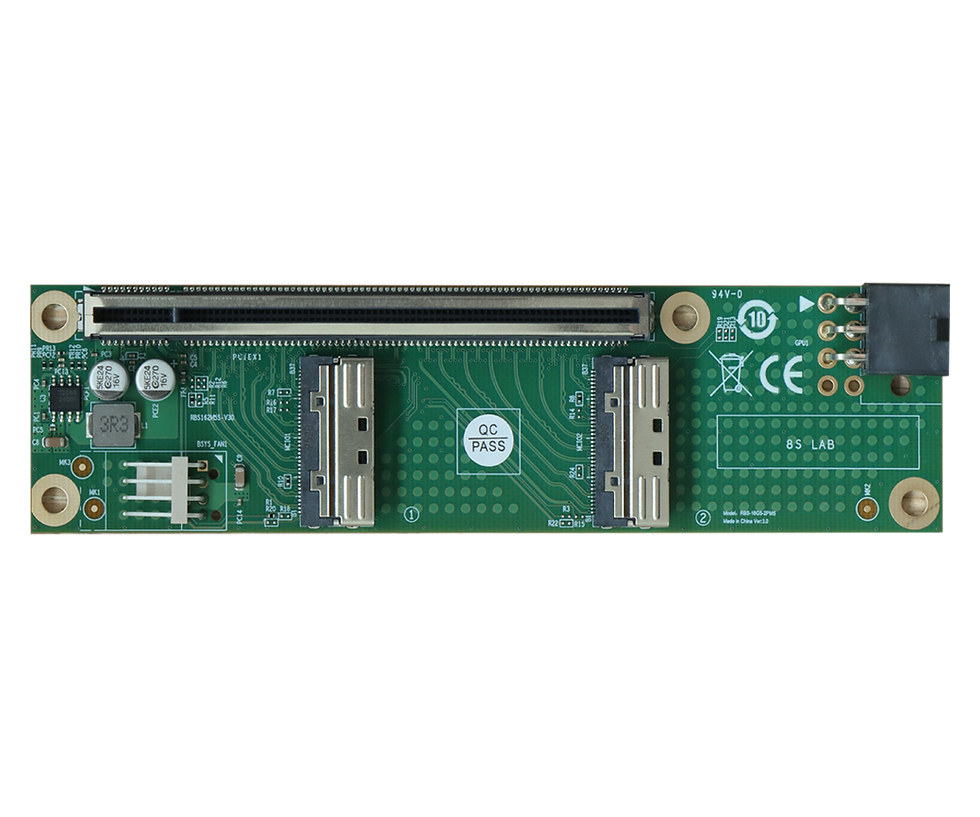
This is the accessory that makes 1U deployment viable. The MCIO-PCIEx16-G5 Bridge Card is a passive expansion component. It does not have a switch chip; instead, it can channel the Rocket 1628A’s PCIe Lanes and Intelligent resource management capabilities via high-integrity MCIO cabling.
The "Remote Slot": Connecting the Bridge Card to the Rocket 1628A effectively "projects" a PCIe x16 slot to a different, more spacious part of the chassis.
True 1U/2U Integration: Because the Bridge Card is small and passive, it can be tucked into the tightest horizontal riser spaces to host a GPU, NIC, or FPGA, while the Rocket 1628A manages the data traffic from a separate area within the server.
Validated Architectural Benefits for the Edge
By utilizing the Rocket 1628A as a centralized hub for one or more Passive Bridge Cards, Edge architects can bypass the physical limitations of standard 1U/2U server platforms:
Engineering Challenge | HighPoint Distributed Solution | Result |
Height Restriction | Low-Profile Switch + Passive Bridge Card. | Full Gen5 x16 power in a slim 1U footprint. |
Signal Integrity | Rocket 1628A manages 32GT/s signals. | Lossless data over flexible 1m MCIO cables. |
Thermal Saturation | Move hot devices away from the Switch & CPU. | Cards stay 20% cooler in high-airflow intake zones. |
Architecture in Action: Composable Edge Nodes
Imagine an Edge AI node that requires a 400G NIC and a high-performance GPU.
· In a standard server chassis, these two hot-running cards are often forced into adjacent slots, leading to immediate thermal throttling and potential hardware failure.
· With the HighPoint Ecosystem, the Rocket 1628A acts as the hub. Two MCIO cables run to two separate Bridge Cards mounted on opposite sides of the chassis.
This is Composable Infrastructure. The Bridge Card provides the physical slot, but the Rocket 1628A provides the switching power. Together, they allow you to ignore the "fixed" layout of the motherboard and build for maximum efficiency.
The Bottom Line: Intelligence Meets Flexibility
HighPoint’s Rocket 1628A proves that a single Low-Profile form factor adapter card can drive a massive, distributed hardware ecosystem. By pairing the switch adapter’s intelligence with the Bridge Card’s physical flexibility, HighPoint enables IT architects to build Edge servers that rival the power of full-sized data centers.
Is your Edge deployment limited by the physical constraints of your chassis?
Learn More


Having a straightforward login guide makes a difference when you are using a platform for the first time. I checked the Dm Win login instructions before signing in because I prefer knowing the process rather than guessing the steps.