.png)
Why HighPoint NVMe RAID Technology Focuses on 0, 1 and 10
The Modern Storage Performance Mandate
The real-world demands of today’s artificial intelligence (AI), high-performance computing (HPC), large language model (LLM) training, and real-time analytics environments require storage infrastructure designed to maximize speed and minimize latency to head off the threat of a compute bottleneck and maintain peak offload performance. This is in direct contrast to storage architecture employed by conventional server/workstation platforms, which generally seek to maintain a balance between performance and redundancy.
While RAID 5 was once considered the “sweet spot” for a cost-efficient storage solution that balances speed and data redundancy, its write-parity overhead and rebuild requirements conflict with the speed-driven mission of modern NVMe Gen4/Gen5 storage media.
HighPoint’s NVMe RAID product line have been engineered to circumvent such problems. Their proven RAID technology enables customers to optimize NVMe configurations for performance or security while avoiding the increased latency associated with parity-based RAID 5 and 6 solutions.

Why RAID 5/6 Falls Short in the NVMe Era
1. Parity Calculation Overhead = Latency
RAID 5 and 6 require parity calculation for every write operation.
For conventional HDDs and SAS/SATA SSD media, this is still acceptable due to the relatively slow speed of each disk (1200MB/s max).
In contrast Gen5 NVMe SSDs utilize the system’s PCIe interface to work directly with the host CPU, and are capable of delivering millions of IOPS 14,000MB/s and transfer speeds; even the slightest parity overhead introduces unnecessary latency.
For workloads where every microsecond matters (AI training pipelines, real-time logging, high-frequency trading, GPU-accelerated workloads), this overhead undermines the very benefits of NVMe storage technology
2. Rebuild Time and URE Risk
While SSD rebuilds are faster than HDD rebuilds, RAID 5 carries the Unrecoverable Read Error (URE) risk during a rebuild.
For RAID 5 and 6 configuration composed of high-capacity NVMe SSDs (15TB, 30TB, and beyond), even a small read errors can jeopardize the functionality of the entire array, triggering rebuild sessions which can cripple performance and negatively impact the lifespan of each SSD.
The HighPoint Solution: Performance Without Compromise
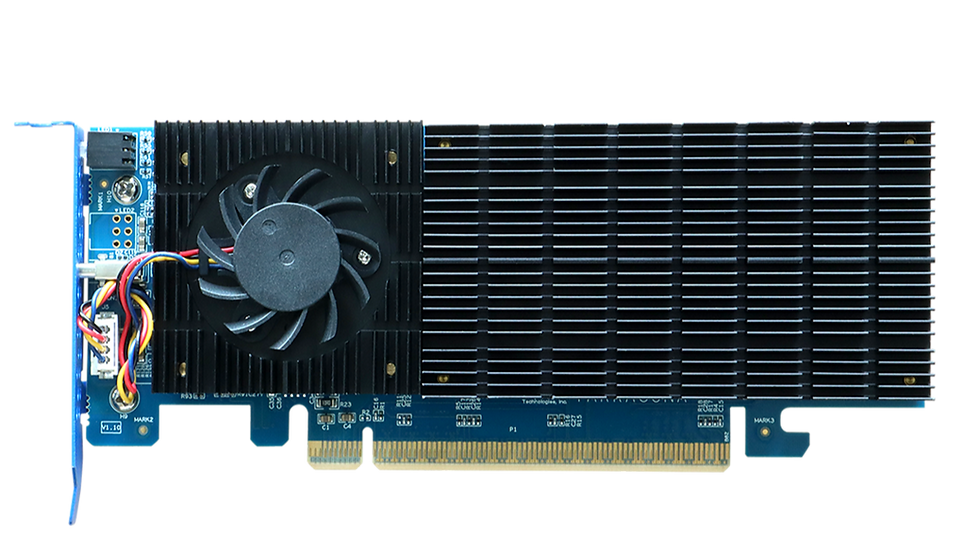
HighPoint’s NVMe Pro/RAID product family, including advanced solutions like the Rocket 7638D, is purpose-built for applications that require absolute throughput with minimal latency.
Direct Data Path Architecture – By combining up to 32 NVMe channels with cutting edge PCIe Switching technology, HighPoint NVMe solutions facilitate direct, uncontended communication between the NVMe media and the host system.
Hardware Assisted RAID 0, 1, and 10 – Delivering linear bandwidth scaling, low-latency mirroring, and balanced striped mirrors without taxing host CPUs.
Readily compatible with leading Third-Party RAID/SDS Solutions – Instead of building-in slower RAID 5/6 support, HighPoint solutions are designed to work in conjunction with advanced software designed storage suites and parity solutions such as:
Linux MDADM (software RAID, flexible parity management)
GRAID SupremeRAID (GPU-accelerated RAID, parity calculations offloaded to GPUs)
ZFS / SDS platforms (software-defined storage with RAID-Z and erasure coding)
This approach ensures HighPoint customers achieve the fastest baseline RAID performance possible while still being able to layer on parity redundancy through higher-level storage stacks when required.
Why RAID 0, 1, and 10 Are the Right Fit
RAID 0 (Striping): Delivers maximum bandwidth for temporary storage, scratch data, and non-critical speed workloads.
RAID 1 (Mirroring): Provides low-latency redundancy for boot drives and critical VMs without compute penalties.
RAID 10 (Striped Mirrors): Balances throughput and redundancy, making it ideal for databases, virtualization storage, and performance-sensitive enterprise workloads.
JBOD/Single Drive: Offers flexibility for software-defined storage (SDS) platforms that prefer direct access to drives.
By focusing on RAID 0, 1 and 10 technology, HighPoint ensures the lowest latency while delivering the highest possible IOPS—goals that RAID 5’s write parity penalties directly conflict with.
Speed Over Compromise
In the era of NVMe storage, RAID 5 is no longer the “middle ground” for high-performance solutions. For many modern applications, it can now be considered bottleneck.
HighPoint’s NVMe RAID product line deliberately omits RAID 5, 6 and other higher-redundancy options for the following reasons:
They add parity overhead where speed is the priority.
They increases rebuild and URE risk with high-capacity SSDs.
Better parity solutions already exist at the software/SDS layer.
HighPoint NVMe RAID focuses on what matters most for modern HPC, AI, and virtualization workloads—speed, low latency, and efficient redundancy with RAID 0, 1, and 10.
For those who need parity protection, the best practice is to pair HighPoint’s Hardware-Accelerated NVMe RAID with advanced parity engines like RAID 6, ZFS, or GPU-accelerated solutions.
In Summary
Modern AI, HPC, and analytics workloads demand ultra-low latency storage that RAID 5/6 can’t deliver due to parity overhead and rebuild risks. HighPoint’s NVMe RAID solutions eliminate these bottlenecks with direct data paths and hardware-assisted RAID 0, 1, and 10, ensuring maximum speed and efficiency. By forgoing parity-based RAID, HighPoint enables uncompromised NVMe performance while remaining compatible with advanced software-defined parity solutions like GRAID and ZFS.
Learn More
HighPoint Adapter NVMe RAID Product Line
HighPoint M.2 AIC NVMe RAID Product Line
HighPoint E1.S AIC NVMe RAID Product Line
HighPoint NVMe Storage Enclosure Product Line
SSD6200 Series 2 & 4-Port PCle Gen3 x8 NVMe RAID Solutions

Comments