.png)
Hardware RAID vs. Hardware-Accelerated NVMe RAID Architecture: A Deep Dive
Updated: Feb 12
The architecture behind a RAID (Redundant Array of Independent Disks) solution directly shapes its performance capabilities—especially in the era of NVMe storage, where maximum throughput and the mitigation of latency define competitive advantage. With workloads spanning AI/ML, HPC, data analytics, and high-resolution media, the industry now differentiates between Traditional Hardware RAID and Hardware-Accelerated NVMe RAID (also known as Hardware-Switched RAID or Hardware-Assisted RAID).
The following article examines both classes of RAID architecture, explaining how they differ, and why understanding these distinctions is crucial for professionals seeking maximum IOPS, low latency, and reliable scalability.
Why RAID Architecture Matters in the NVMe Era
RAID has long been a cornerstone of enterprise grade storage technology. Its original mission was simple: enhance the redundancy, consistency, and performance of SAS and SATA HDD-based storage solutions. However, with the advent of NVMe media, which is capable of delivering millions of IOPS with ultra-low latencies measured in milliseconds, the limitations of conventional legacy architecture are increasingly hard to ignore.
The key question today: How have RAID architectures evolved to keep pace with NVMe performance?
Traditional Hardware RAID (Legacy ROC-Based Architecture)
Focus: Optimized for slower legacy drives (HDDs, SAS, SATA SSDs).
· Core Components: A dedicated RAID-on-Chip (ROC) processor, onboard DRAM cache, and often a Battery Backup Unit (BBU).
· How It Works: The ROC manages parity, I/O scheduling, and error correction. The accompanying DRAM buffers write operations, which is essential for high-latency platter-based storage devices. The BBU helps preserve data in the case of a power outage.
· Performance Bottleneck: ROCs were engineered for SAS/SATA interfaces which require considerably less bandwidth than NVMe media to perform optimally. This design struggles to scale when paired with NVMe SSDs, which are designed to interface directly with the host CPU via the system’s PCIe bus, and can quickly saturate all available PCIe lanes. A single Gen5 NVMe SSD can deliver 14000MB/s of performance – over 10 times faster than a 12G SAS drive! Conventional ROC/cache architecture can simply not keep pace with modern NVMe storage.
Bottom Line: While robust for hard disk drive media and SAS/SATA workloads, traditional Hardware RAID Architecture was not engineered to support the extreme parallelism of NVMe storage technology.
Hardware-Accelerated NVMe RAID (Modern Switch-Based)
Focus: Designed specifically to maximize NVMe’s inherent parallelism and efficiency.
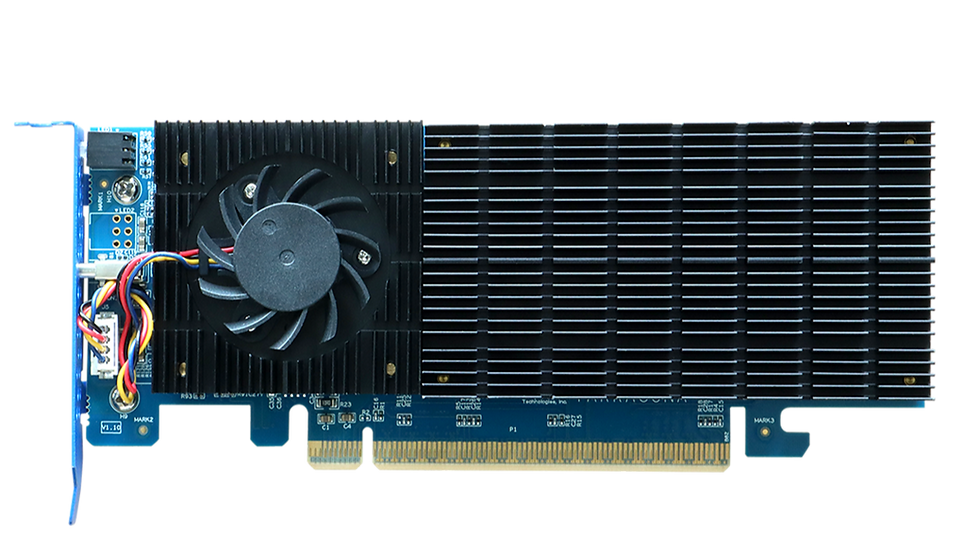
· Core Component: A high-port-count PCIe Switch Integrated Circuit (IC). Example: the HighPoint Rocket 7608A, which is armed with an internal 48-lane PCIe Gen5 Switch IC and can directly host up to 8 M.2 SSDs and 64T of storage.
· How It Works: The Rocket 7608A’s PCIe switch acts as a high-speed traffic manager, routing I/O directly between the host platform and NVMe SSDs. Instead of managing heavy parity calculations, the switch firmware optimizes data pathways for hosted RAID 0/1/10 and JBOD configurations.
· Performance Edge: By minimizing caching layers and leveraging the advantages of native NVMe latency with dedicated PCIe bandwidth, this architecture all but eliminates performance bottlenecks, creating direct, highly parallel paths between the storage devices and host system.
Bottom Line: Designed for speed, scalability, and low latency, Hardware-Accelerated RAID is the natural fit for NVMe.
Performance Optimization: RAID Levels Compared
RAID 0 & JBOD: Pure Speed and Bandwidth
· RAID 0 (Striping): Each NVMe SSD maintains its own dedicated PCIe x4 lane. Bandwidth aggregates linearly, guaranteeing near-perfect scaling across drives.
· JBOD: Ideal for software-defined storage (SDS). The switch simplifies I/O routing, presenting each hosted SSD as an individual drive, through a unified PCIe interface without bandwidth contention.
RAID 1 & RAID 10: Low Latency with Redundancy
· RAID 1 (Mirroring): The switch handles write duplication internally, delivering faster, more consistent mirroring without consuming host CPU cycles.
· RAID 10 (Striped Mirrors): Combines striping for speed and mirroring for data protection. The PCIe switch balances read/write operations across pairs, delivering high IOPS and stable throughput—ideal for mission-critical workloads.
Key Advantages of Hardware-Accelerated NVMe RAID
1. True PCIe Bandwidth Scaling – Unlocks the full potential of Gen4/Gen5 x16 connectivity with no ROC bottlenecks.
2. Ultra-Low Latency – Direct NVMe to host communication minimizes processing overhead.
3. High Parallelism – Perfect for AI/ML pipelines, HPC clusters, and large-scale analytics.
4. Flexible Configurations – Optimizes RAID 0, 1, 10, or JBOD configurations without straining host resources.
5. Future-Proof Design – Fully aligned with today’s fastest PCIe Gen5 NVMe SSDs, while maintaining backwards compatibility with previous generation hardware.
Why It Matters: Real-World Impacts
· AI & Machine Learning: Ensures GPUs are never “data starved” by maximizing throughput to training datasets.
· Scientific Computing: Accelerates reconstruction and modeling where massive I/O loads are routine.
· Media Production: Guarantees smooth playback and editing of 8K/16K video without dropped frames.
· Enterprise Backup & SDS: Offers high density, redundancy, and efficiency for petabyte-scale deployments.
Learn More
In Summary: Evolving Beyond Legacy RAID Technology
Traditional hardware RAID was revolutionary in the HDD era. But in the NVMe world, Hardware-Accelerated RAID is the clear leader. By replacing the ROC bottleneck with a high-speed PCIe switch fabric, this architecture unleashes the full potential of NVMe storage, delivering linear scaling, ultra-low latency, and unmatched efficiency for modern workloads.
For organizations seeking to maximize ROI on NVMe deployments, Hardware-Accelerated RAID is not just an upgrade—it’s a requirement.

hello